Pathfinder
This project is an exploration into how AI can be implemented to create better experiences for users outside of their screens. Our goal was to target a user’s decision fatigue and mental burden in daily tasks to give them more time to focus on other things in their life. We chose to narrow our focus on planning how users run errands and hoped to create a more enjoyable experience that provides more than just helping complete a necessary chore. As a smart errand planner, this program allows users to list the tasks they need to complete and — in turn — will generate a customized plan unique to each users’ needs. Any task that requires decision making and involves a person’s personal habits is sensitive to being automated because of the need to incorporate personal preferences. This is where AI creates a more reliable and trustworthy solution, as their personal preferences are ‘remembered’ and taken into account when creating solutions.
By Sofia Harmon, Grace Ho, Rutuja Nagulpelli
User Interviews
Our first step of mapping out this project was conducting user interviews to get a better understanding into how our target audience currently plans their errands. Additionally, we used this forum as a way to gauge their current usage of AI in daily tasks and their openness to further implementation. Through these interviews, different frustrations and priorities bubbled up giving us insight into what an ideal workflow would look like for users in planning their errands.
Findings
Preliminary Research
One of the most apparent findings was the shared desire for efficiency among users. Users prioritize their time and value spending it meaningfully. Because of this, when planning their errands their main concern tends to be optimizing their route either by time or geography. Additionally, users tend to view running errands as a chore rather than something they find enjoyable. In thinking about ways to improve this experience, users shared the added value of unexpected delights, like chancing upon a new or interesting location. Our users mostly found frustration when things diverted from their original plan or expectations, like longer than anticipated wait times. Lastly, we found that users were generally open to the use of AI in daily tasks, despite not actually using it currently.
AI Concept Summary
Personas
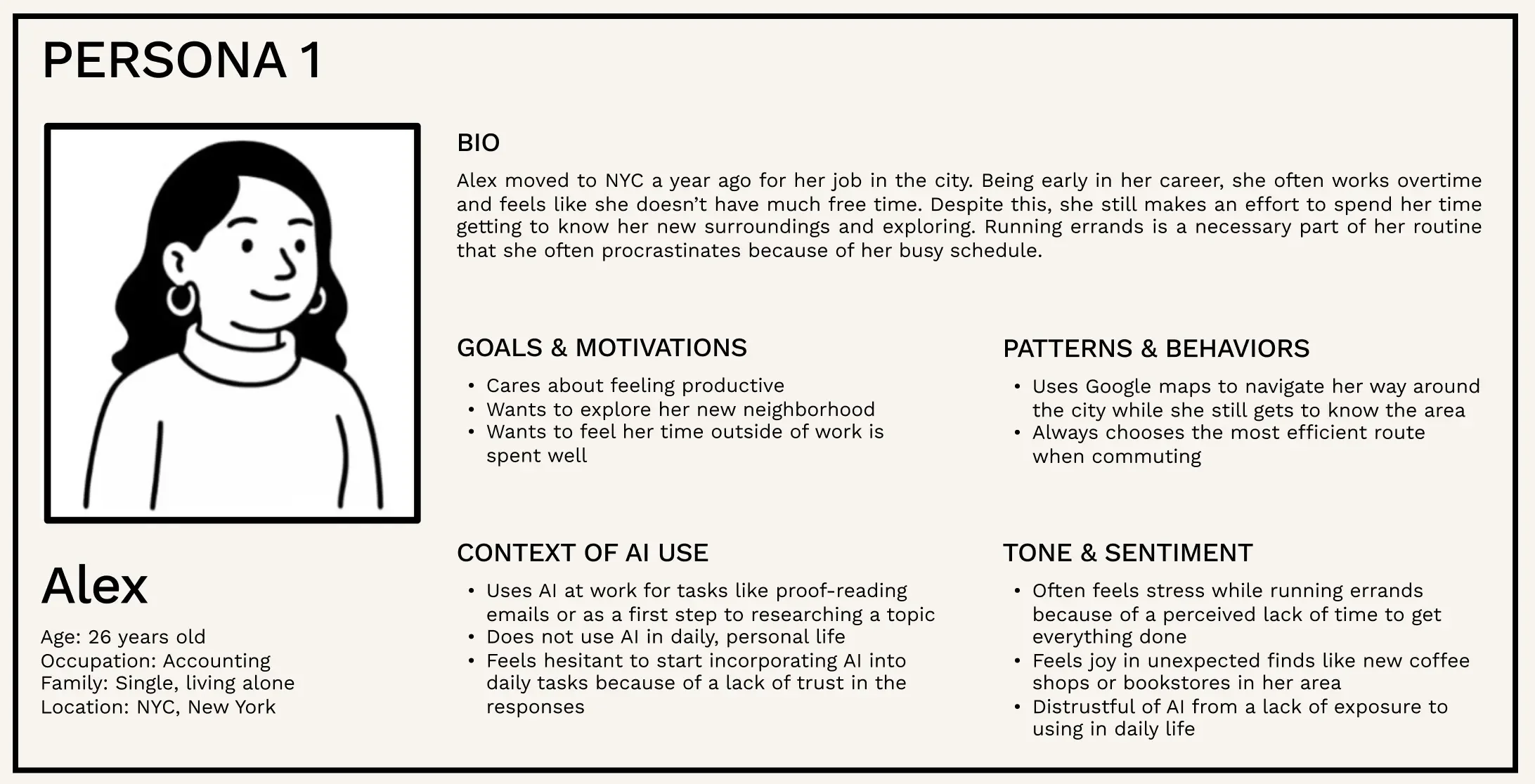
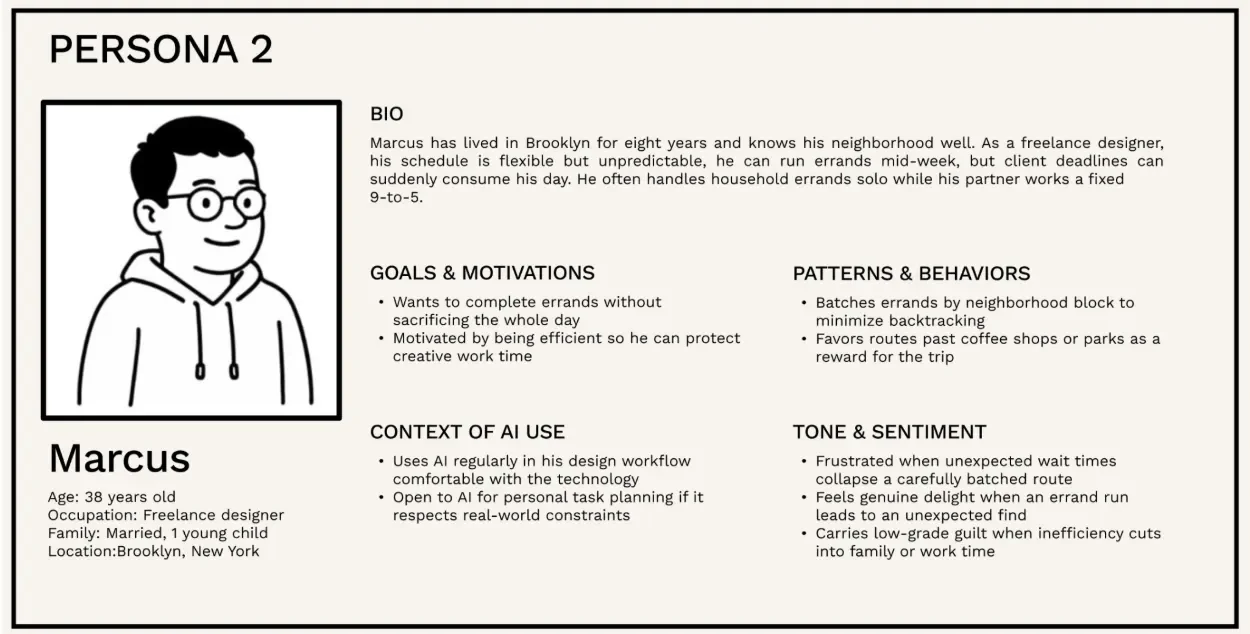
After completing our initial research into user behavior, we compiled what we learned into two personas to represent the target audience that we are designing for. Both of these personas are busy adults who live in walkable cities where finding time to plan and run errands is not always easy. Using AI we were able to create custom GPTs to make our personas interactive and give us the ability to mimic a user interview, further expanding our understanding of user habits.
Role of AI
The role of AI in this project is to create a customized and adaptive experience for users. The differentiator between this project being implemented with and without AI is the way in which it will learn from previous use to improve the output. In traditional apps, all users with the same input (task list) will always get the same output (generated route). This doesn’t solve for relieving users of decision fatigue or the mental burden of planning their routes because the generic responses will still need review and revisions from the user to make it fit for them. The AI-enhanced solution makes the generated output already custom fit for the user, skipping over the mental processing step for the user.
Initial Prototype
This project implements generative, predictive and personalization AI to generate routes and plans for users. The generative AI is used in creating the actual deliverable for the user. Based on certain inputs — some given by the user and some inferred from other indicators — the program generates a fully functional plan to be used as an itinerary for the user in running errands. The personalization AI is used in tandem with the generative AI to learn from previous user behavior to create more personalized content for the user. This aims to create a better long-term user experience, as the recommendations become more custom fit to their needs. Lastly, predictive AI will be used to anticipate tasks or routes that the user will need. The predictive and personalized behavior will work to create and experience where the user feels that the program ‘knows’ them.
Prototyping
Our initial wireframes were created using Figma Make to generate visuals based on prompts that synthesized our research findings. We did this by using the insights we found in our interviews and ideating how our app could solve for the frustrations that were surfaced. Using AI we generated mood boards, journey maps, and early concepts on the app to help visualize how our prototype would look and feel. After mapping out these concepts and creating these visuals, we uploaded these into AI along with textual descriptions that better explain the desired functionality. AI was able to generate these early prototypes based on our input and through a few rounds of adding comments
Types of AI
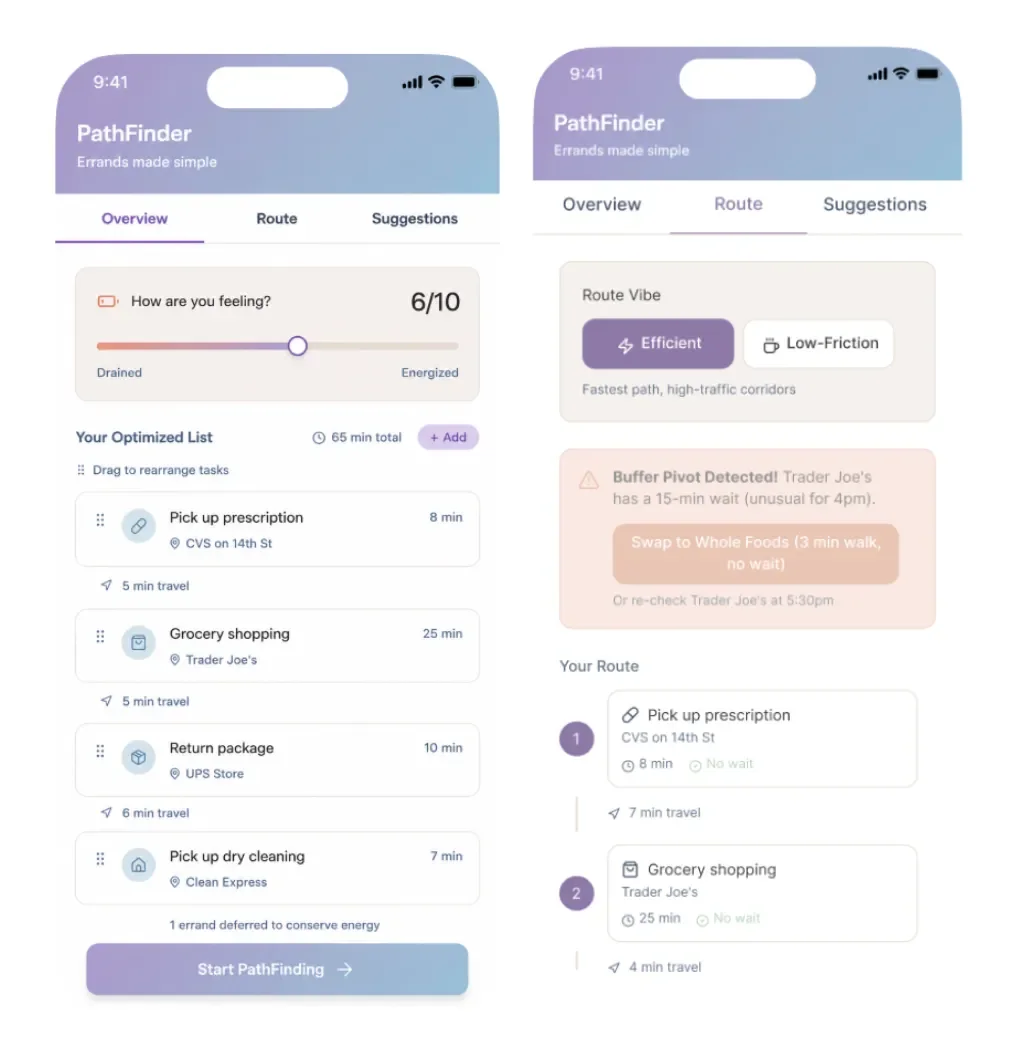
For our final prototype, we were able to take the initial wireframes that were created and vibe code a functional prototype. This was the most impactful use of AI for this project as it took our concepts and quickly brought it to life without needing us to have technical knowledge to execute the development.
Key Learnings
Final Prototype
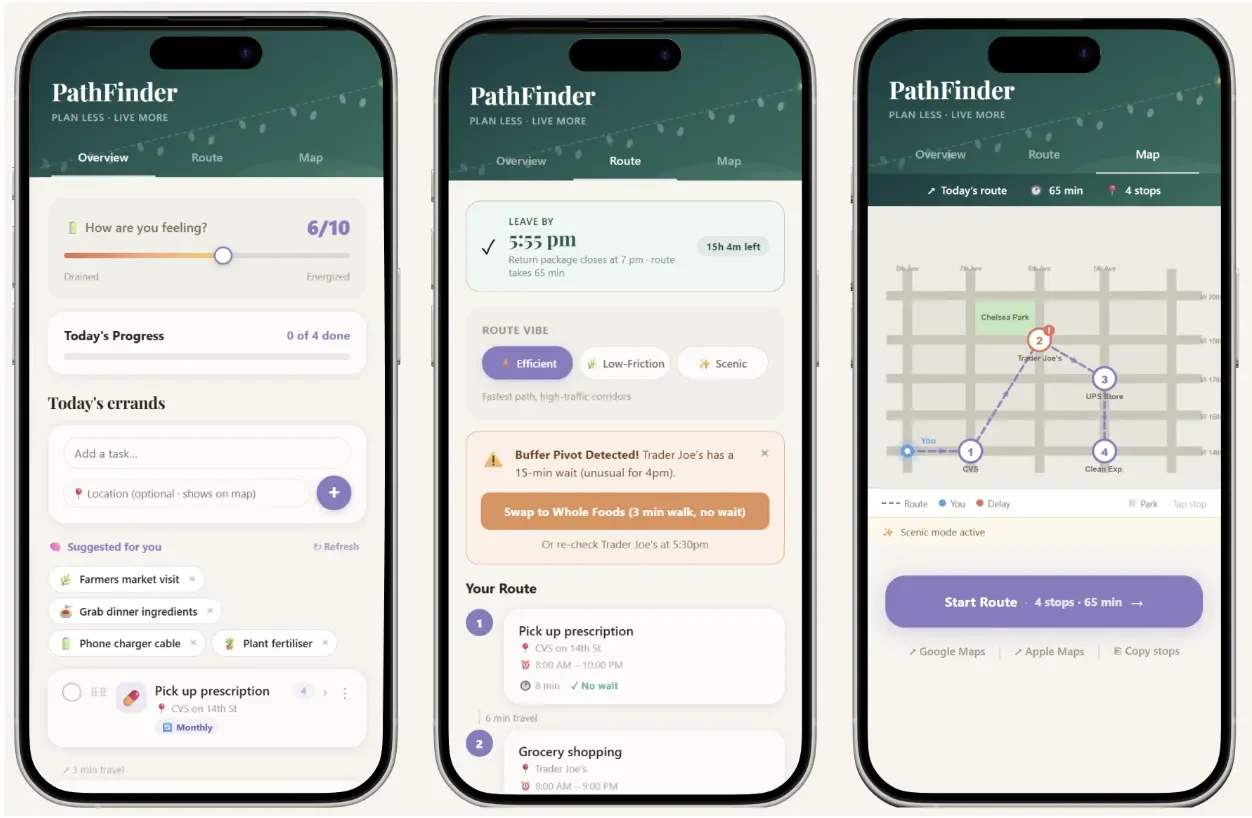
AI was used in multiple ways throughout the process of this project as an exploration of its capabilities. From the start, AI was used in synthesizing our research and user interviews into clear insights to compare against our own found insights to see any patterns that we missed. I found that AI is extremely useful in textual based analysis like summarizing text or pulling out insights. Aside from the obvious use of ideating implementation of AI, there were many other use cases for AI like generating visuals, creating early wireframes, and even vibe coding a functional prototype. One main takeaway from this project was learning how vast the capabilities of AI are and how AI can be used as a tool for anyone to create a more efficient workflow.
Next Steps
My next steps for this project would be to push the exploration of AI a bit further to make this a truly end-to-end AI-assisted project. It would be interesting to see if we could take the vibe-coded prototype and turn it into a fully functional application using Claude Code. This would include setting up a database and doing the coded implementation with AI. I imagine this would typically take weeks of development but with the way AI has been rapidly evolving could be completed much faster and with less prior technical knowledge.