Using Service Design to Improve Client Services for Pratt’s DX Center
The Center for Digital Experiences (DX) is a faculty-led UX consultancy department within Pratt that collaborates with non-profit organizations to provide them with an assortment of student-built UX services. The department connects students in certain classes with these external clients to give them an opportunity to create projects that will be implemented for real users. Despite the success of the program, the service creates undue stress on the DX Center coordinators as the demand for clients increases. Our goal was to evaluate the system and propose service interventions to help the program scale with a more balanced workload amongst the different actors.
By Sofia Harmon, Riley Knowles, Conner Meek, Sophia Liu, Qinraocuomu Nari
Research
Initial User Interviews
The first step of our research process was interviewing some of the main actors of the DX center client service. In order to get an idea of how the system works we first met with Craig who is the main coordinator of the DX Center. During this initial interview, Craig walked us through his client recruitment, documentation, and coordination processes. Following this interview, we next spoke with Sam who is another coordinator with the DX Center and a professor at Pratt. Being that she transitioned from being a user of the service as a professor to being one of the facilitators of the service, she was able to provide a unique perspective into the pain points of the service.
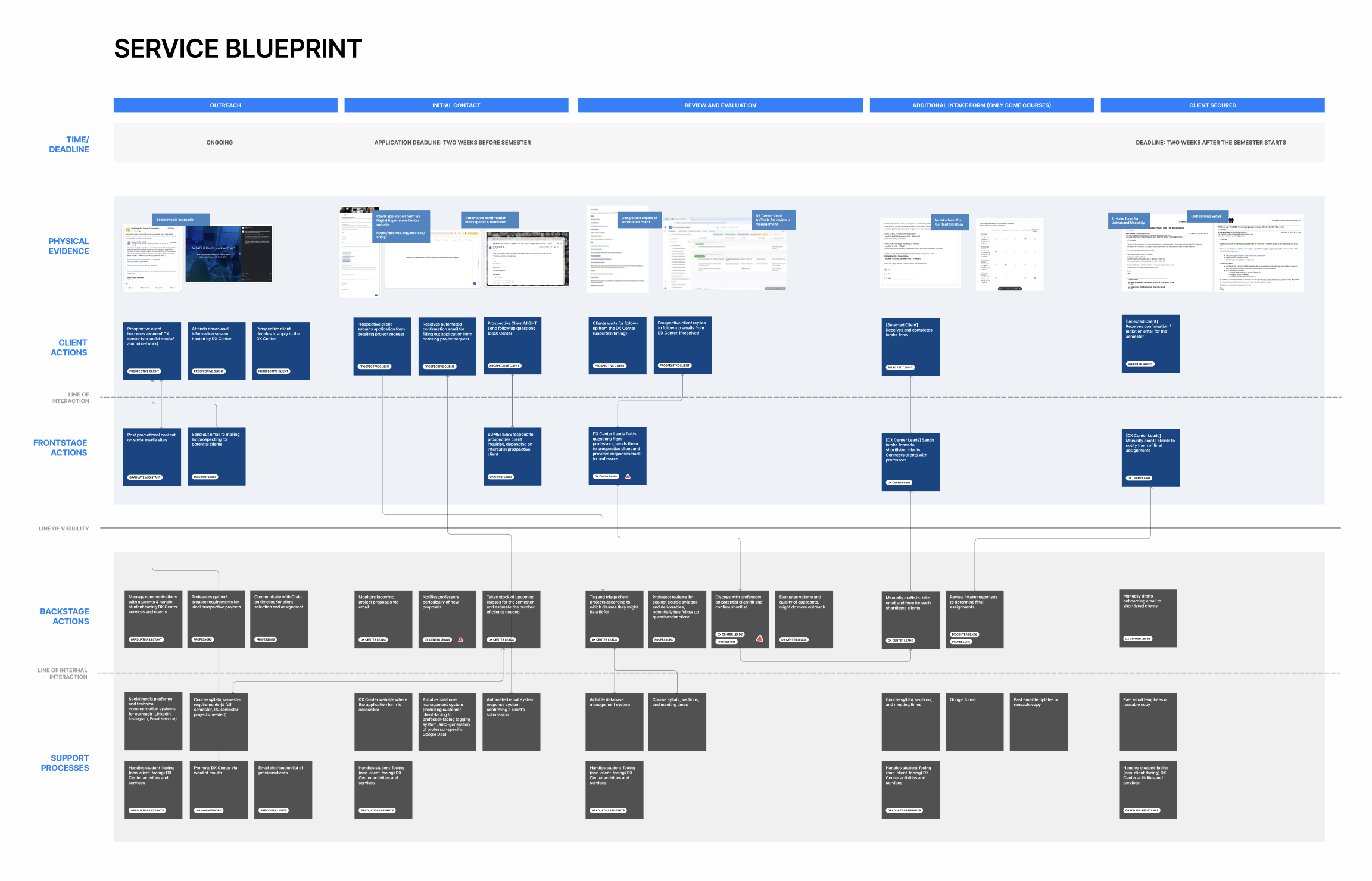
Service Blueprint
The first step of our research process was interviewing some of the main actors of the DX center client service. In order to get an idea of how the system works we first met with Craig who is the main coordinator of the DX Center. During this initial interview, Craig walked us through his client recruitment, documentation, and coordination processes. Following this interview, we next spoke with Sam who is another coordinator with the DX Center and a professor at Pratt. Being that she transitioned from being a user of the service as a professor to being one of the facilitators of the service, she was able to provide a unique perspective into the pain points of the service.
Co-deign Workshop
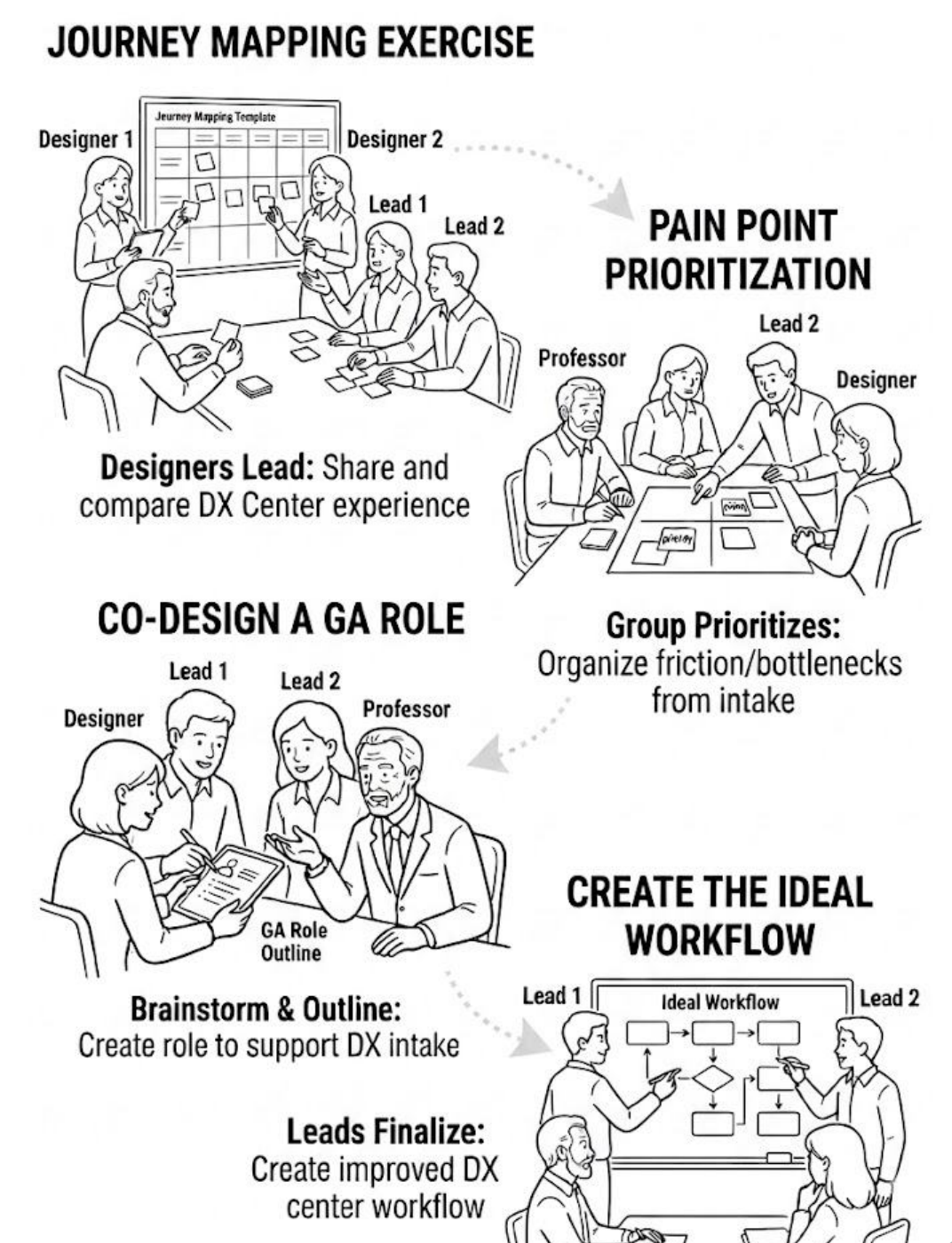
We conducted a co-design session with the goal of building a shared understanding of the current intake experience and identifying opportunities for improvement. The workshop included exercises in journey mapping, pain point identification, and creating an ideal workflow — all with the goal of gaining a better understanding of the current process from the perspective of different actors and identifying weaknesses in the system that can be improved.
This allowed us to co-create directly with actors in the process to better understand how they interact with the service. Instead of needing to guess where the bottlenecks were and what a reasonable solution would be, co-design allowed us to let the users explain the problems and talk through solutions that would actually benefit them.
Findings
While synthesizing our findings from our interviews and journey mapping exercise, our team began to notice common themes that emerged from the actors’ frustrations. Firstly, the intake process relies heavily on informal coordination, where progress depends on individuals following up, clarifying, and pushing tasks forward, creating inconsistency and delays, especially when multiple stakeholders are involved. The timing of the process and when stakeholders are brought into the process also creates friction due to mismatched expectations that are difficult to resolve once projects are already underway.
Through a co-design exercise aimed at creating an ideal workflow, we noted three areas to focus on: transparency and early involvement by the professors, established templates or artifacts, and improved client management processes. Emphasizing professor involvement and establishing common templates for communication can foster a more reliable and predictable experience for professors to help ease any anxieties around the recruitment process. While, improving the client management process will help to reestablish a communication system that avoids the current bottleneck through the DX Center, creating a better experience for clients and faculty.
Service Interventions
Graduate Assistant Role
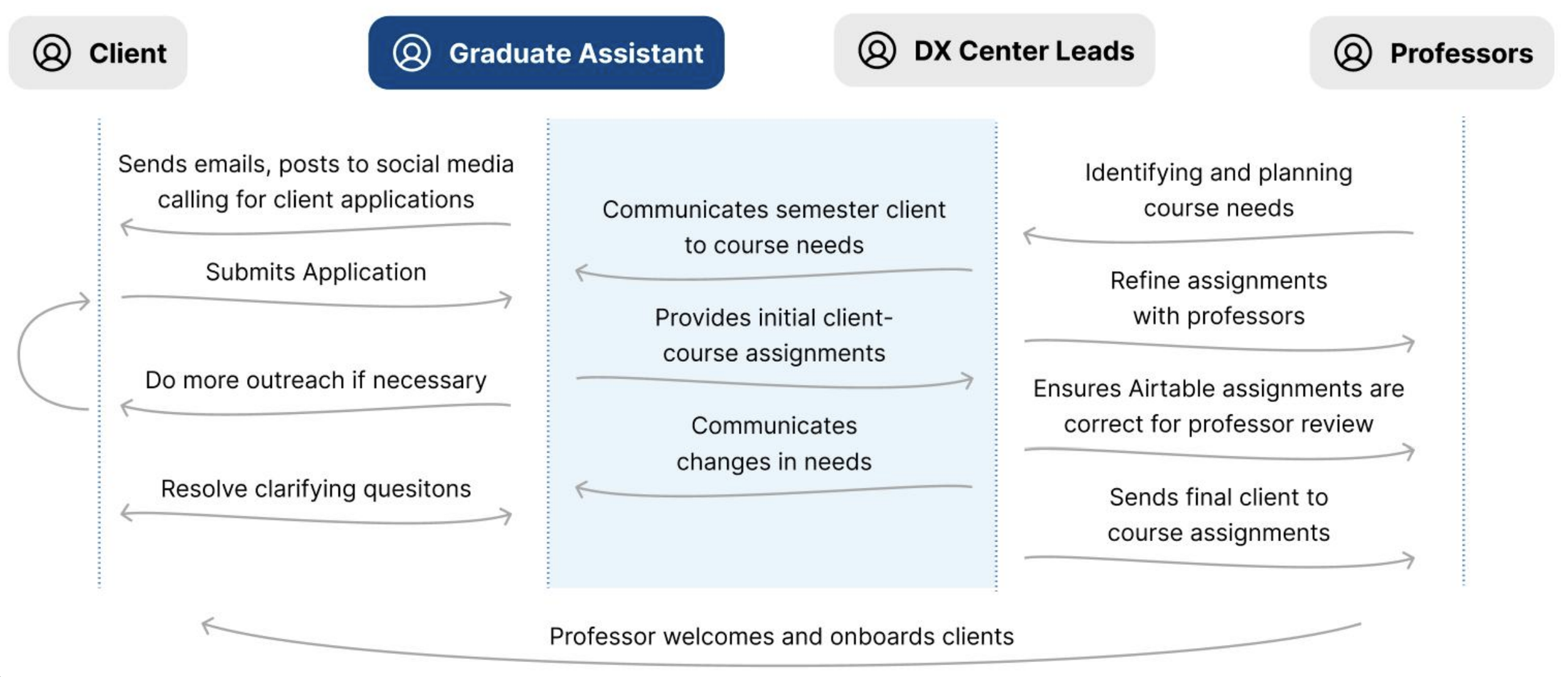
To help redistribute some of the workload on the DX Center, we proposed a new role for graduate assistants who would help offload some of the coordination and communication work. The new graduate assistant role would serve as an Account Manager for the client, assisting in client and internal faculty communication. In turn, DX Center internal processes are able to run more smoothly since DX Center personnel no longer need to balance the work of internal processes and external communication.
The new role would be a mix of account management, content ownership, and cross-functional coordination. Responsibilities for this position would include ownership of the client recruitment and communication process, maintenance of recruitment email templates, and coordination between internal faculty and external clients. This gives students a unique opportunity to build client relation management skills that are directly transferable to future jobs.
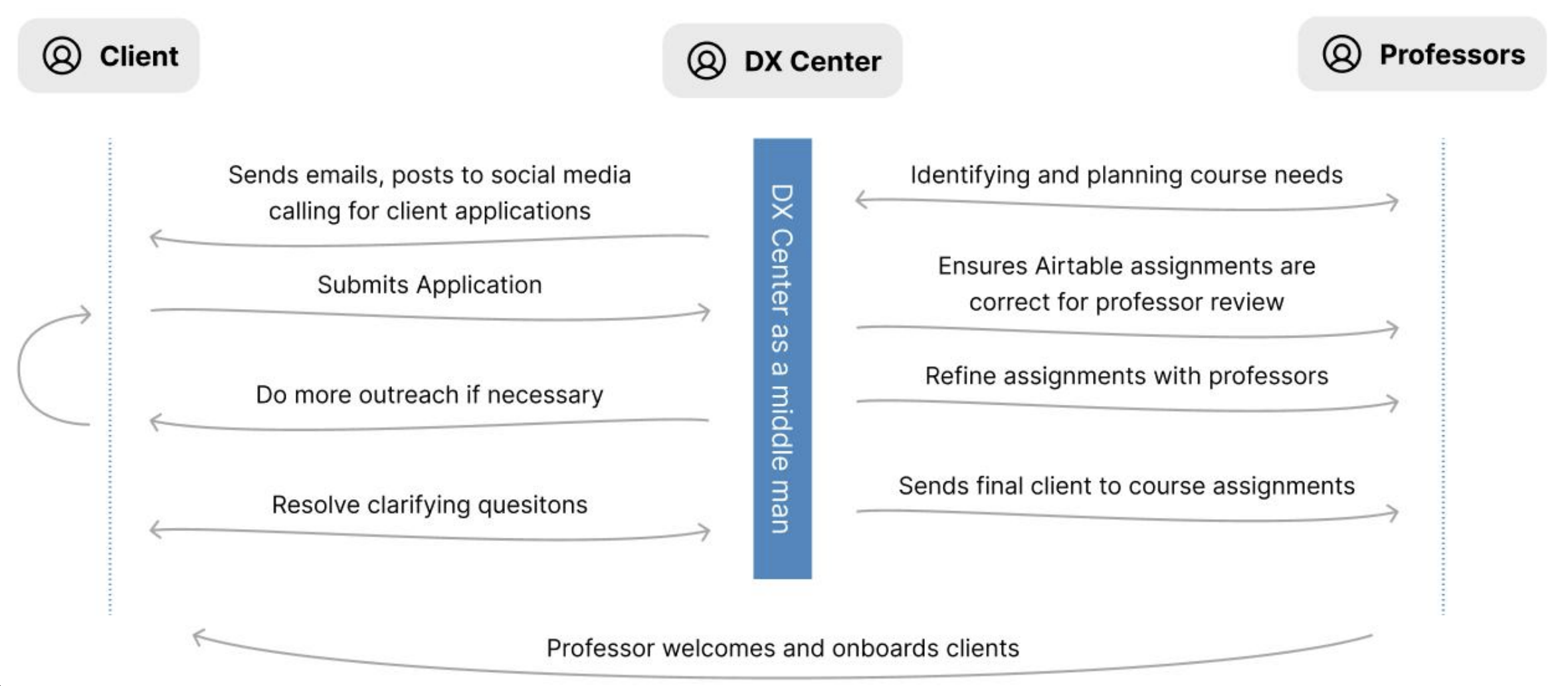
Current Ecosystem:
Proposed Ecosystem with Graduate Assistant:
Faculty Onboarding Kit
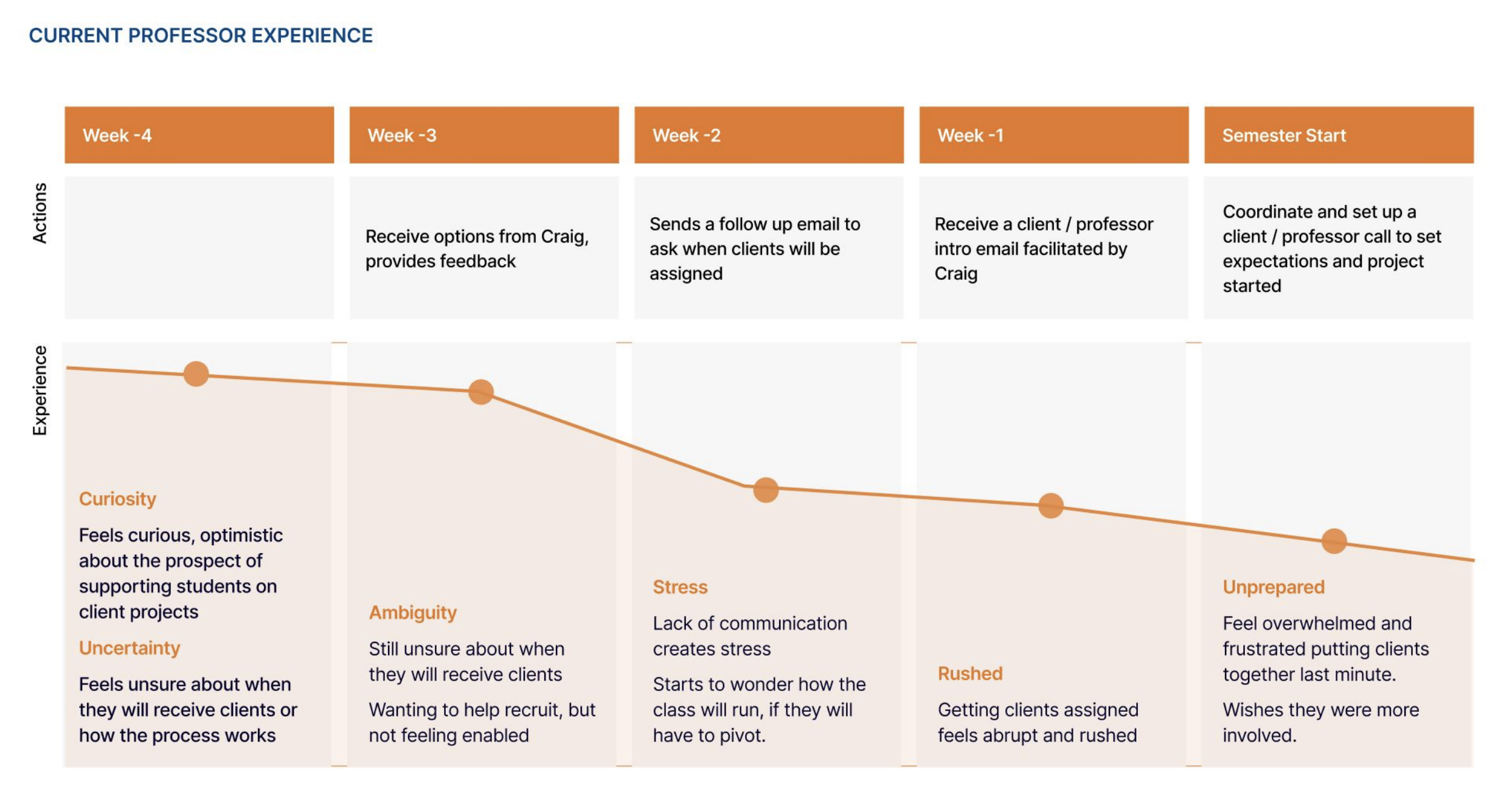
As it stands, Professors are not currently part of the client recruitment process, limiting their ability to advocate for their course’s needs. This also further emphasizes the “DX center bottleneck” by putting all of the recruitment work on the DX Center. This lack of visibility understandably creates uncertainty and stress in the Professors about the quality and quantity of clients they’ll be allocated for their course.
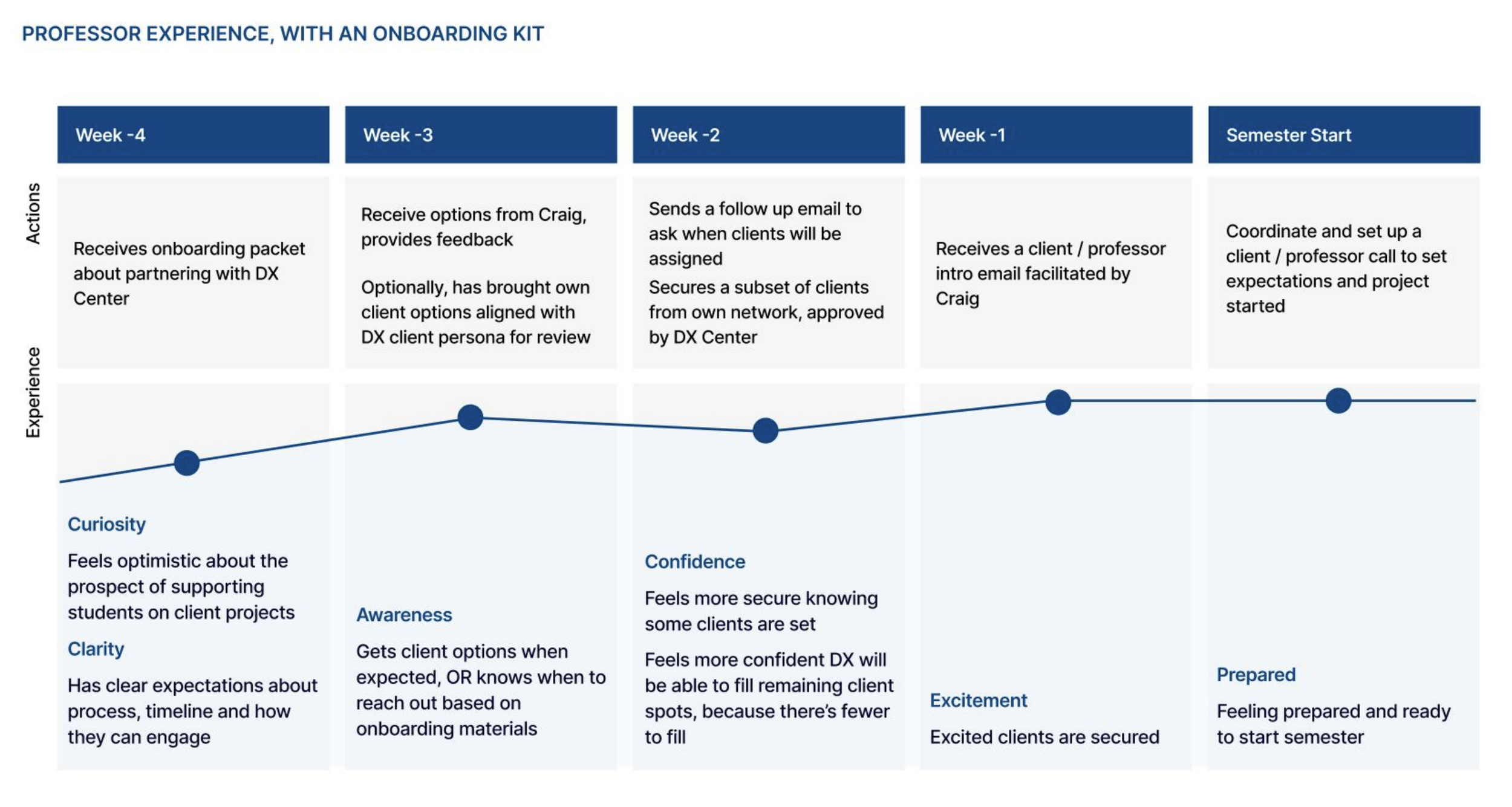
To address this, we proposed adding a Faculty Onboarding Kit to help explain the recruitment process. This aims to create transparency around the client intake and communication process, giving the Professors more independence and responsibility within their own processes. The kit would include an overview of the collaboration process, a well-defined recruitment timeline, email templates and recruitment materials, and guidance on client communication. All of these resources would aim to better prepare professors for what to expect and how to navigate client relationships.
Next Steps
Identifying Risks
Finally after creating our service interventions we tried to imagine scenarios where the interventions would not function well or create risks in the system. In creating a graduate assistant role with increased responsibility, there exists a risk in overwhelming the student and rendering them unable to complete their work. This would clearly create stress on the student as they are already trying to navigate balancing course work and workload, but additionally it would create stress on the DX Center who would need to fill in the gaps to ensure the work is being done. To avoid this, we want to ensure the students are provided with guidance and mentorship from DX Center coordinators who can help them when they have issues, to avoid the work piling up and overwhelming them.
Another risk that is posed by onboarding professors onto the recruitment process is the possibility of inconsistent communication that leads to more confusion between clients and the DX Center. By providing an onboarding kit with structured materials for communications, we hope to ensure communication stays consistent creating a more fluid and expectable experience.
Feedback
Our final step is sharing our findings and interventions with the DX Center for feedback on our proposed solutions. If any concerns or questions come up, we will want to incorporate feedback from clients into the solutions so they can adapt to the needs of the client. Finally, we will want to follow up with the DX Center post-implementation to check in on how the interventions work in practice.